I finally got around to looking at Private Wakefield's papers from the National Archives at Kew. Some more information has come to light:
(1) He was born in 1897 in Kingstown, St. Vincent and may have a very tenuous connection with St. Kitts, Nevis and Anguilla.
(2) By 1914 he was attending St. Paul's School in Hammersmith Road, London (the school is now located in Barnes).
(3) He was called up while attending the school as a 'Medical Student' and joined the East Surrey Regiment as a private.
(4) On the same day he was attached to the Royal Field Artillery Officer Cadet training school at St. John's Wood, London. This was because he was a member of the Officer Training Corps (OTC) at St. Paul's School.
(5) He died about a month after enlisting due to disease.
(6) There was some disagreement between his father and the War Office regarding what should be written on his remembrance scroll and plaque. The official line was that as Officer Cadet was not a rank the inscriptions would read 'Private Ivor Mccrae Wakefield - East Surrey Regiment'. His father thought otherwise and that he should be noted as an Officer Cadet not a Private. After some discussion internally the War Office official line was that 'attached to RFA Officer Cadet school' could be added to the Scroll and Plaque.
His father/family must have felt very strongly about this as he is remembered as an Officer Cadet not as a Private on the family grave (not a CWGC maintained grave) in Richmond (London) cemetery.
His father, Arthur Wakefield, was a Bank Manager probably with the Colonial Bank (later part of Barclays Bank). He must have spent some time in St. Vincent as his two daughters were born there as well.
Some more questions are raised but it may be difficult to answer them easily such as his connection with St. Kitts. Something may turn up though.

20 January 2014
Ivor McCrae Wakefield and the CWGC
The Commonwealth War Graves Commission had Ivor McCrae Wakefield recorded as J. M. Wakefield. After I had notified them of the error with supporting documention they have amended their records. As previously mentioned on other blog entries he is commemorated on The St. Kitts War Memorial World War One plaque.
08 January 2014
From the Western Front to St. Kitts
A number of narrow-gauge engines were constructed during World War One by Britain to haul supplies and transport personnel to and from the front line on the Western Front. These rail systems were known as the War Department Light Railways (WDLR). Other combatants also used light railways on the Western Front.
One of the locomotives, a 'Motor Rail' Open design LR2156 (Builder's number 435 of 1917), found a new life in St. Kitts after the war. It became a workhorse on the St. Kitts narrow gauge railway pulling wagons transporting sugar cane from around the island to the central sugar factory.
It was rebuilt for this new role by being converted from 2ft to 2ft 6ins gauge by its makers and numbered 3663 of 1924. It was repatriated to the United Kingdom and was re-gauged and refurbished with a diesel engine. It has made appearances at various events and its home is presently on the Ffestiniog Railway in Wales.

One of those obsure links between World War One and St. Kitts.
Festiniog Railway: http://www.festrail.co.uk/
For information about WDLR and other light railways used on the Western Front during World War One: http://www.wdlr.org.uk/
The sugar light railway on St. Kitts has been converted into a tourist attraction since the sugar industry closed in 2005: http://www.stkittsscenicrailway.com/
One of the locomotives, a 'Motor Rail' Open design LR2156 (Builder's number 435 of 1917), found a new life in St. Kitts after the war. It became a workhorse on the St. Kitts narrow gauge railway pulling wagons transporting sugar cane from around the island to the central sugar factory.
It was rebuilt for this new role by being converted from 2ft to 2ft 6ins gauge by its makers and numbered 3663 of 1924. It was repatriated to the United Kingdom and was re-gauged and refurbished with a diesel engine. It has made appearances at various events and its home is presently on the Ffestiniog Railway in Wales.
One of those obsure links between World War One and St. Kitts.
Festiniog Railway: http://www.festrail.co.uk/
For information about WDLR and other light railways used on the Western Front during World War One: http://www.wdlr.org.uk/
The sugar light railway on St. Kitts has been converted into a tourist attraction since the sugar industry closed in 2005: http://www.stkittsscenicrailway.com/
07 January 2014
St. Kitts-Nevis 'War Tax' Stamps
The "War Tax" stamps were issued during World War I to help fund the war effort. Generally these stamps were regular stamp issues that were overprinted with the words "WAR", "WAR TAX" or "WAR STAMP".
The War Tax Acts in most colonies and countries stated that the War Tax stamps were to be used in addition to whatever postage fees were due on the item being mailed (postcards, letters and parcels). While the stamps were supposed to be used just to pay for the War Tax, many times they were also used to pay part of the postage and registration fees (as long as the total amount with the war tax was correct, it appears that most countries did not seem to mind).
St Kitts-Nevis followed the pattern of the other Leeward Islands colonies. In October 1916 the ½d stamp appeared overprinted “WAR TAX”. Then in August 1918 there was the issue of a special printing of a 1½d stamp, in orange, this time overprinted ‘WAR STAMP”.
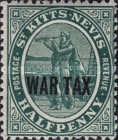


'WAR STAMPS. By Rule made in Council on 12th February, 1917 the St. Kitts-Nevis 1/2 d. green (Columbus design) was surcharged WAR TAX. Owing to the demand, on account of increased postage rates, for a 1-1/2 d. stamp, in July, 1918, a St. Kitts-Nevis (Columbus design) Stamp of the value of "one penny half penny" (orange colour), surcharged WAR STAMP, was printed and issued throughout the Presidency. The issue of these stamps ceased after the conclusion of peace.'
- p.121 A Handbook of St. Kitts-Nevis. 1920
The War Tax Acts in most colonies and countries stated that the War Tax stamps were to be used in addition to whatever postage fees were due on the item being mailed (postcards, letters and parcels). While the stamps were supposed to be used just to pay for the War Tax, many times they were also used to pay part of the postage and registration fees (as long as the total amount with the war tax was correct, it appears that most countries did not seem to mind).
St Kitts-Nevis followed the pattern of the other Leeward Islands colonies. In October 1916 the ½d stamp appeared overprinted “WAR TAX”. Then in August 1918 there was the issue of a special printing of a 1½d stamp, in orange, this time overprinted ‘WAR STAMP”.
'WAR STAMPS. By Rule made in Council on 12th February, 1917 the St. Kitts-Nevis 1/2 d. green (Columbus design) was surcharged WAR TAX. Owing to the demand, on account of increased postage rates, for a 1-1/2 d. stamp, in July, 1918, a St. Kitts-Nevis (Columbus design) Stamp of the value of "one penny half penny" (orange colour), surcharged WAR STAMP, was printed and issued throughout the Presidency. The issue of these stamps ceased after the conclusion of peace.'
- p.121 A Handbook of St. Kitts-Nevis. 1920
03 January 2014
Officer Cadet Ivor Wakefield
Officer Cadet Ivor Wakefield's service records have been copied and sent to me by the National Archives in Kew, but as I am 4,000 miles away I will not be looking at them just yet. Something to look forward too and that should finally close the case on him. Every avenue available has been explored I think.
21 October 2013
Private Ivor Wakefield - Information Hunt Continues!
Finding information about Private Ivor Wakefield, East Sussex Regiment has taken many twists and turns. I have finally found a service record for him that is held at the National Archive in Kew, Surrey, UK. It would appear and it has confirmed that after his initial conscription he became an Officer Cadet and joined an Officer Cadet Battalion. I have ordered a copy of his record so I will wait and see what unfolds from that.
07 September 2013
Ivor Wakefield (2)
A little more research on Ivor. Received his death certificate and it shows he died at East Grinstead Isolation Hospital after becoming ill at Maresfield Training Camp. Though he was in the East Surrey Regiment he was training to be an officer either in the Royal Garrison Regiment (RGA) or the Royal Artillery Regiment (RFA). It would appear that his army service record was destroyed in 1940 during a German air raid.
Subscribe to:
Posts (Atom)