Showing posts with label leeward islands. Show all posts

08 August 2014

St. Kitts, Nevis and Anguilla: 4th August 1914 Remembered?

The Colony of St. Kitts, Nevis and Anguilla changed status with regard to the United Kingdom in 1967, to become a Dependent Territory and granted full internal autonomy. The island of Anguilla rebelled against this new arrangement as the inhabitants considered that they would be worse off. Finally in 1980, Anguilla formally remained a Dependent Territory of the United Kingdom allowing St. Kitts and Nevis to progress on to full independence in 1983.

As the 4th August 2014 commemorated the centenary of the start of World War One it is interesting to note the only mention of the commemoration was made by the Governer of Anguilla, Christina Scott, in 'The Anguillan', dated 1st August 2014.

The First World War 100 years on: why we should remember.

Next Monday, the fourth of August 2014 marks the 100th anniversary of Britain’s entry into the First World War. In the United Kingdom and across the battlefields of Europe, events will commemorate the centenary, and remember all those who lost their lives, from all sides, between 2014 and 2018.
In Glasgow, a major Commemoration Service will take place in the city’s magnificent Cathedral, consecrated in 1197, and which has seen more than 800 years of continuous worship under one roof. The solemn service will bring together royalty and political leaders from Europe, as well as leaders from across the Commonwealth and Overseas Territories. The Chief Minister will represent Anguilla.
Although many think of the First World War as a conflict which took place in Europe, it covered four continents and three oceans. Among those who took part were thousands of soldiers from the Caribbean, many of whom fought with distinction and were awarded for their bravery.
There are records of soldiers and sailors from the Caribbean having fought for Britain since the 18th century and there had been a West Indian Regiment since 1790. Soldiers from the West Indies had fought with honour, including Private Samuel Hodge, who was the first black soldier to be awarded the Victoria Cross, in 1866.
At the start of the First World War, a battalion of the West India Regiment was stationed in Africa where they fought in the campaign to take the German colony in Cameroon. In 1915 the British Government formed a second unit made up of volunteers from the Caribbean which was named the British West Indies Regiment. Mostly this was made up of men who had made their way to Britain and had joined various military units. They saw action in modern day Kenya and Tanzania, where they took part in the successful battle to take control of Dar es Salaam, and then fought in Jordan and Palestine against the forces of Turkey. Later, in Europe, they saw service in France, Flanders and Italy.
Whilst most officers in the British West Indies Regiment were transferred in from other units of the British army, some officers with proud Caribbean roots served in the British army itself. Perhaps most famous of these is Walter Tull, whose father came from Barbados, and who played football for Tottenham Hotspur and Northampton Town before the start of the war. He was commissioned from the ranks in 1917 but tragically died before the end of the war after serving in Italy and France. A statue to his memory stands outside the ground of Northampton Town Football Club.
It wasn’t just the army in which men from the Caribbean served. William Robinson Clarke joined the Royal Flying Corp as a flight engineer and then flew as a pilot from 1917. Others served in the Royal Navy and saw service in engagements such as the Battle of Coronel off the coast of Chile and at the Battle of Jutland, the largest naval battle of the war. It is thought that up to 19,000 men from the Caribbean served in the armed forces of Britain from 1914 to 1918. Eighty-one medals were won for bravery of which sixty-one were awarded to officers and men of the British West Indies Regiment.
Anguilla too made its contribution. Private Peter A. Carter was one of at least two Anguillians known to have fought in the First World War. The other was Johnson Emile Gumbs. There may also have been a third. Peter left Anguilla in 1915 for Britain where he underwent four months of rigorous training before joining the British West Indies Regiment in campaigns in France and Italy.
In 1917 the unit in which Peter was serving was bombed by German warplanes. His foxhole was covered with debris and he was presumed dead having been missing for three days. Peter managed to dig himself out of his foxhole and was lucky to survive with only a wounded left leg in which a piece of shrapnel was embedded and which remained there until his sad passing in 1974. Peter was the only member of his unit to survive the bombing on that fateful day. He was the recipient of two medals: the Victory Medal and the British War Medal.
As the fourth of August approaches, and as we remember the men and woman who died in the war which it was hoped would end all wars, it is right that we pause to reflect on the sacrifices made by those from Anguilla and across the Caribbean. They travelled thousands of miles to serve a country that most had never seen. Their courage and commitment, and defence of the freedoms that we enjoy today, should not be forgotten.

HE The Governor Christina Scott
(with grateful thanks to Colville Petty for information about Private Carter)


http://theanguillian.com/2014/08/the-first-world-war-100-years-on-why-we-should-remember/

20 January 2014

Ivor McCrae Wakefield and the CWGC

The Commonwealth War Graves Commission had Ivor McCrae Wakefield recorded as J. M. Wakefield. After I had notified them of the error with supporting documention they have amended their records. As previously mentioned on other blog entries he is commemorated on The St. Kitts War Memorial World War One plaque.

08 January 2014

From the Western Front to St. Kitts

A number of narrow-gauge engines were constructed during World War One by Britain to haul supplies and transport personnel to and from the front line on the Western Front. These rail systems were known as the War Department Light Railways (WDLR). Other combatants also used light railways on the Western Front.

One of the locomotives, a 'Motor Rail' Open design LR2156 (Builder's number 435 of 1917), found a new life in St. Kitts after the war. It became a workhorse on the St. Kitts narrow gauge railway pulling wagons transporting sugar cane from around the island to the central sugar factory.

It was rebuilt for this new role by being converted from 2ft to 2ft 6ins gauge by its makers and numbered 3663 of 1924. It was repatriated to the United Kingdom and was re-gauged and refurbished with a diesel engine. It has made appearances at various events and its home is presently on the Ffestiniog Railway in Wales


One of those obsure links between World War One and St. Kitts.

Festiniog Railway: http://www.festrail.co.uk/
For information about WDLR and other light railways used on the Western Front during World War One: http://www.wdlr.org.uk/
The sugar light railway on St. Kitts has been converted into a tourist attraction since the sugar industry closed in 2005: http://www.stkittsscenicrailway.com/

07 January 2014

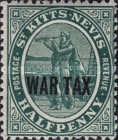
St. Kitts-Nevis 'War Tax' Stamps

The "War Tax" stamps were issued during World War I to help fund the war effort.   Generally these stamps were regular stamp issues that were overprinted with the words "WAR", "WAR TAX" or "WAR STAMP".

The War Tax Acts in most colonies and countries stated that the War Tax stamps were to be used in addition to whatever postage fees were due on the item being mailed (postcards, letters and parcels). While the stamps were supposed to be used just to pay for the War Tax, many times they were also used to pay part of the postage and registration fees (as long as the total amount with the war tax was correct, it appears that most countries did not seem to mind).

St Kitts-Nevis followed the pattern of the other Leeward Islands colonies. In October 1916 the ½d stamp appeared overprinted “WAR TAX”. Then in August 1918 there was the issue of a special printing of a 1½d stamp, in orange, this time overprinted ‘WAR STAMP”.


'WAR STAMPS. By Rule made in Council on 12th February, 1917 the St. Kitts-Nevis 1/2 d. green (Columbus design) was surcharged WAR TAX. Owing to the demand, on account of increased postage rates, for a 1-1/2 d. stamp, in July, 1918, a St. Kitts-Nevis (Columbus design) Stamp of the value of "one penny half penny" (orange colour), surcharged WAR STAMP, was printed and issued throughout the Presidency. The issue of these stamps ceased after the conclusion of peace.'
- p.121 A Handbook of St. Kitts-Nevis. 1920

07 September 2013

Ivor Wakefield (2)

A little more research on Ivor. Received his death certificate and it shows he died at East Grinstead Isolation Hospital after becoming ill at Maresfield Training Camp. Though he was in the East Surrey Regiment he was training to be an officer either in the Royal Garrison Regiment (RGA) or the Royal Artillery Regiment (RFA). It would appear that his army service record was destroyed in 1940 during a German air raid.

14 July 2013

The Missing Man of World War 2!

Eugene Dunlop Vanier:

b. 14th February 1916, Charlestown, Nevis, British West Indies - d. 1st September 1942, Libya/Egypt.

It would appear that the name of Flying Officer, Eugene Dunlop Vanier, Royal Canadian Air Force (RCAF) has not been included on the 1939-1945 plaque of the St. Kitts Memorial. His aircraft a Bristol Beaufighter, T4881 of 252 (RAF) Squadron and was reported missing whilst on strafing operations behind enemy lines around the Libyan/Egyptian border. His aircraft with one other on the operation failed to return to base on 1st September 1942 and the crew were  presumed to have been killed in action. His body was never recovered and his name is remembered on the Alamein Memorial in Egypt.

Pilot Officer Eugene Vanier

As recorded on the Commonwealth War Graves Commission (CWGC) web site he was the son of the Revd. John George William Vanier, B.A., and Mary Annie Vanier, of Basseterre, St. Kitts, British West Indies.

Revd. John Vanier was also an Anglican Priest living at the Rectory, The Valley, Anguilla in 1913, just prior to the commencement of World War 1. He was described as a Priest in Holy Orders at St. Mary's Church and that he was 'Coloured'.

From Anglican missionary reports in 1916/17 the diocese of Antigua had adjusted to the war, but Rev John Vanier of St Thomas, Nevis, stressed that trouble among the labouring classes was coming to a head with the formation of a trade union (June 1917).

So it would appear that Eugene's father the Revd. John Vanier had served as an Anglican priest in Anguilla, Nevis and St. Kitts. Eugene also spent time in Antgua being educated at Antigua Grammar School, working for the Post Office in Antigua and George W. Bennett Bryson & Co., Ltd, In 1939 he went to McGill University from 1939 until joining the RCAF in August 1940.