08 August 2014

St. Kitts, Nevis and Anguilla: 4th August 1914 Remembered?

The Colony of St. Kitts, Nevis and Anguilla changed status with regard to the United Kingdom in 1967, to become a Dependent Territory and granted full internal autonomy. The island of Anguilla rebelled against this new arrangement as the inhabitants considered that they would be worse off. Finally in 1980, Anguilla formally remained a Dependent Territory of the United Kingdom allowing St. Kitts and Nevis to progress on to full independence in 1983.

As the 4th August 2014 commemorated the centenary of the start of World War One it is interesting to note the only mention of the commemoration was made by the Governer of Anguilla, Christina Scott, in 'The Anguillan', dated 1st August 2014.

The First World War 100 years on: why we should remember.

Next Monday, the fourth of August 2014 marks the 100th anniversary of Britain’s entry into the First World War. In the United Kingdom and across the battlefields of Europe, events will commemorate the centenary, and remember all those who lost their lives, from all sides, between 2014 and 2018.
In Glasgow, a major Commemoration Service will take place in the city’s magnificent Cathedral, consecrated in 1197, and which has seen more than 800 years of continuous worship under one roof. The solemn service will bring together royalty and political leaders from Europe, as well as leaders from across the Commonwealth and Overseas Territories. The Chief Minister will represent Anguilla.
Although many think of the First World War as a conflict which took place in Europe, it covered four continents and three oceans. Among those who took part were thousands of soldiers from the Caribbean, many of whom fought with distinction and were awarded for their bravery.
There are records of soldiers and sailors from the Caribbean having fought for Britain since the 18th century and there had been a West Indian Regiment since 1790. Soldiers from the West Indies had fought with honour, including Private Samuel Hodge, who was the first black soldier to be awarded the Victoria Cross, in 1866.
At the start of the First World War, a battalion of the West India Regiment was stationed in Africa where they fought in the campaign to take the German colony in Cameroon. In 1915 the British Government formed a second unit made up of volunteers from the Caribbean which was named the British West Indies Regiment. Mostly this was made up of men who had made their way to Britain and had joined various military units. They saw action in modern day Kenya and Tanzania, where they took part in the successful battle to take control of Dar es Salaam, and then fought in Jordan and Palestine against the forces of Turkey. Later, in Europe, they saw service in France, Flanders and Italy.
Whilst most officers in the British West Indies Regiment were transferred in from other units of the British army, some officers with proud Caribbean roots served in the British army itself. Perhaps most famous of these is Walter Tull, whose father came from Barbados, and who played football for Tottenham Hotspur and Northampton Town before the start of the war. He was commissioned from the ranks in 1917 but tragically died before the end of the war after serving in Italy and France. A statue to his memory stands outside the ground of Northampton Town Football Club.
It wasn’t just the army in which men from the Caribbean served. William Robinson Clarke joined the Royal Flying Corp as a flight engineer and then flew as a pilot from 1917. Others served in the Royal Navy and saw service in engagements such as the Battle of Coronel off the coast of Chile and at the Battle of Jutland, the largest naval battle of the war. It is thought that up to 19,000 men from the Caribbean served in the armed forces of Britain from 1914 to 1918. Eighty-one medals were won for bravery of which sixty-one were awarded to officers and men of the British West Indies Regiment.
Anguilla too made its contribution. Private Peter A. Carter was one of at least two Anguillians known to have fought in the First World War. The other was Johnson Emile Gumbs. There may also have been a third. Peter left Anguilla in 1915 for Britain where he underwent four months of rigorous training before joining the British West Indies Regiment in campaigns in France and Italy.
In 1917 the unit in which Peter was serving was bombed by German warplanes. His foxhole was covered with debris and he was presumed dead having been missing for three days. Peter managed to dig himself out of his foxhole and was lucky to survive with only a wounded left leg in which a piece of shrapnel was embedded and which remained there until his sad passing in 1974. Peter was the only member of his unit to survive the bombing on that fateful day. He was the recipient of two medals: the Victory Medal and the British War Medal.
As the fourth of August approaches, and as we remember the men and woman who died in the war which it was hoped would end all wars, it is right that we pause to reflect on the sacrifices made by those from Anguilla and across the Caribbean. They travelled thousands of miles to serve a country that most had never seen. Their courage and commitment, and defence of the freedoms that we enjoy today, should not be forgotten.

HE The Governor Christina Scott
(with grateful thanks to Colville Petty for information about Private Carter)


http://theanguillian.com/2014/08/the-first-world-war-100-years-on-why-we-should-remember/

18 April 2014

Private Ivor Mccrae Wakefield - Some More Questions and Answers.

I finally got around to looking at Private Wakefield's papers from the National Archives at Kew. Some more information has come to light:

(1) He was born in 1897 in Kingstown, St. Vincent and may have a very tenuous connection with St. Kitts, Nevis and Anguilla.
(2) By 1914 he was attending St. Paul's School in Hammersmith Road, London (the school is now located in Barnes).
(3) He was called up while attending the school as a 'Medical Student' and joined the East Surrey Regiment as a private.
(4) On the same day he was attached to the Royal Field Artillery Officer Cadet training school at St. John's Wood, London. This was because he was a member of the Officer Training Corps (OTC) at St. Paul's School.
(5) He died about a month after enlisting due to disease.
(6) There was some disagreement between his father and the War Office regarding what should be written on his remembrance scroll and plaque. The official line was that as Officer Cadet was not a rank the inscriptions would read 'Private Ivor Mccrae Wakefield - East Surrey Regiment'. His father thought otherwise and that he should be noted as an Officer Cadet not a Private. After some discussion internally the War Office official line was that 'attached to RFA Officer Cadet school' could be added to the Scroll and Plaque.
His father/family must have felt very strongly about this as he is remembered as an Officer Cadet not as a Private on the family grave (not a CWGC maintained grave) in Richmond (London) cemetery.

His father, Arthur Wakefield, was a Bank Manager probably with the Colonial Bank (later part of Barclays Bank). He must have spent some time in St. Vincent as his two daughters were born there as well.

Some more questions are raised but it may be difficult to answer them easily such as his connection with St. Kitts. Something may turn up though.

20 January 2014

Ivor McCrae Wakefield and the CWGC

The Commonwealth War Graves Commission had Ivor McCrae Wakefield recorded as J. M. Wakefield. After I had notified them of the error with supporting documention they have amended their records. As previously mentioned on other blog entries he is commemorated on The St. Kitts War Memorial World War One plaque.

08 January 2014

From the Western Front to St. Kitts

A number of narrow-gauge engines were constructed during World War One by Britain to haul supplies and transport personnel to and from the front line on the Western Front. These rail systems were known as the War Department Light Railways (WDLR). Other combatants also used light railways on the Western Front.

One of the locomotives, a 'Motor Rail' Open design LR2156 (Builder's number 435 of 1917), found a new life in St. Kitts after the war. It became a workhorse on the St. Kitts narrow gauge railway pulling wagons transporting sugar cane from around the island to the central sugar factory.

It was rebuilt for this new role by being converted from 2ft to 2ft 6ins gauge by its makers and numbered 3663 of 1924. It was repatriated to the United Kingdom and was re-gauged and refurbished with a diesel engine. It has made appearances at various events and its home is presently on the Ffestiniog Railway in Wales. 


One of those obsure links between World War One and St. Kitts.

Festiniog Railway: http://www.festrail.co.uk/
For information about WDLR and other light railways used on the Western Front during World War One: http://www.wdlr.org.uk/
The sugar light railway on St. Kitts has been converted into a tourist attraction since the sugar industry closed in 2005: http://www.stkittsscenicrailway.com/

07 January 2014

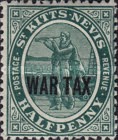
St. Kitts-Nevis 'War Tax' Stamps

The "War Tax" stamps were issued during World War I to help fund the war effort.   Generally these stamps were regular stamp issues that were overprinted with the words "WAR", "WAR TAX" or "WAR STAMP".

The War Tax Acts in most colonies and countries stated that the War Tax stamps were to be used in addition to whatever postage fees were due on the item being mailed (postcards, letters and parcels). While the stamps were supposed to be used just to pay for the War Tax, many times they were also used to pay part of the postage and registration fees (as long as the total amount with the war tax was correct, it appears that most countries did not seem to mind).

St Kitts-Nevis followed the pattern of the other Leeward Islands colonies. In October 1916 the ½d stamp appeared overprinted “WAR TAX”. Then in August 1918 there was the issue of a special printing of a 1½d stamp, in orange, this time overprinted ‘WAR STAMP”.


'WAR STAMPS. By Rule made in Council on 12th February, 1917 the St. Kitts-Nevis 1/2 d. green (Columbus design) was surcharged WAR TAX. Owing to the demand, on account of increased postage rates, for a 1-1/2 d. stamp, in July, 1918, a St. Kitts-Nevis (Columbus design) Stamp of the value of "one penny half penny" (orange colour), surcharged WAR STAMP, was printed and issued throughout the Presidency. The issue of these stamps ceased after the conclusion of peace.'
- p.121 A Handbook of St. Kitts-Nevis. 1920

03 January 2014

Officer Cadet Ivor Wakefield

Officer Cadet Ivor Wakefield's service records have been copied and sent to me by the National Archives in Kew, but as I am 4,000 miles away I will not be looking at them just yet. Something to look forward too and that should finally close the case on him. Every avenue available has been explored I think.

21 October 2013

Private Ivor Wakefield - Information Hunt Continues!

Finding information about Private Ivor Wakefield, East Sussex Regiment has taken many twists and turns. I have finally found a service record for him that is held at the National Archive in Kew, Surrey, UK. It would appear and it has confirmed that after his initial conscription he became an Officer Cadet and joined an Officer Cadet Battalion. I have ordered a copy of his record so I will wait and see what unfolds from that.

07 September 2013

Ivor Wakefield (2)

A little more research on Ivor. Received his death certificate and it shows he died at East Grinstead Isolation Hospital after becoming ill at Maresfield Training Camp. Though he was in the East Surrey Regiment he was training to be an officer either in the Royal Garrison Regiment (RGA) or the Royal Artillery Regiment (RFA). It would appear that his army service record was destroyed in 1940 during a German air raid.

26 August 2013

Ivor Wakefield

Private Ivor McCrea Wakefield, East Surrey Regiment
Not a good start researching Ivor as the Commonwealth War Graves Commission website list him as J M Wakefield.
Soldiers That Died in the Great War show his name as Ivor and that he was born in 'British West India'. I also payed a visit to his grave in Richmond Cemetery in South West London and his name is commemorated on a family grave as 'Cadet Ivor Wakefield, RGA, 1897-1917'.
So a note to the CWGC to see if his details can be checked and amended.
He does not appear to have qualified for any war medals as he only served at 'home' and was attached to the Royal Field Artillery (RFA) as noted in SDGW.
Next on the list is ordering a death certificate to find out how and where he died.


12 August 2013

From the Caribbean to New York and Canada

Searching through the names has also turned up the fact that some of the men joined the British Army in New York or travelled on to Canada for education purposes prior to the war starting and then joining the Canadian armed forces.

Imitation information at Ellis Island - www.ellisisland.org - has proved useful in tracking down some of the names.

05 August 2013

Week off - sunny weather!

Always a problem when there is good weather in the UK. I can't stay home with the sun out. Anyway back to business. Trying to identify some details associated with the 20 names on the St. Kitts war memorial.
First stop the Commonwealth War Graves Commissions site and Soldiers Who Died in the Great War and then the UK National Archives to look at the World War One Medal indexes.

20 July 2013

Records Here, Records There, Records Gone.

Looking for military records associated with World War One and the Caribbean throws up a number of challenges. The location of St. Kitts, Nevis and Anguilla and the political and economic associations of the time present opportunities for population movement. These can be from island to island, island to the United Kingdom, island to Canada and island to United States and island to central America principally Panama. Added to this a number of records have disappeared or have been destroyed.

British Army Records after 1913

Army non-commissioned officers and other ranks
Due to German bombing during Worlds War 2 some 60% of service records were destroyed at the beginning of World War 2. On the night of the 7th/8th September 1940 the War Office Record Store in Arnside Street, Walworth, London SE17 was hit by incendiary bombs during a heavy German air-raid. The resulting fire destroyed the greater part of the 1,400 tons of War Office records which were held there. Approximately two thirds of soldiers' service records were completely destroyed and those which survived were partly charred or water damaged when the fire was extinguished; the surviving records became known as the series WO 363 'burnt documents or burnt collation'.

Some army service records were stored off site for pension claim purposes.

Surviving records have been microfilmed and can be viewed at the Public Record Office, Kew, London
Non commissioned officers and other ranks, First World War, WO 363, WO364 and WO400.
Service Records are also available via the genealogy website http://home.ancestry.co.uk/ for a fee.

Army Officers records.
First World War Regular Army and Emergency Reserve Officers were registered with a 'Long Number' in series, WO 339, with index to long numbers, WO338 that is used to find army officers service records. 
First World War Temporary commissions and Territorial Army Officers, are recorded in series WO 374.

I have managed to find some of the Service Records of the men named on the St. Kitts War Memorial which has helped provide some pieces of the jig-saw puzzle.


18 July 2013

20 Names, 20 Lives! The Search Begins

The St. Kitts War Memorial has twenty names listed on a brass plaque commemorating those who lost their lives during the First World War 1914-1918. At the moment they are just names but they were living breathing people who were sons, brothers, uncles and husbands. So who were these men:

First stop the Commonwealth War Graves Commission web site. http://www.cwgc.org

Established in May 1917 as the Imperial War Graves Commission it holds the burial and memorial records of 1.69 deceased Commonwealth military service personnel. They also manage and maintain over 23,000 burial sites in approximately 2,500 cemeteries and over 200 memorials in a total of 150 countries.


The names listed in the CWGC database have varying degrees of information e.g. forname(s) could be in full or just initials. Additional information regarding place of birth and next of kin might or might not be included.

The bracketed number below refers to the name placing on the War Memorial plaque. Having reviewed the names:

Definite identification:

(1) Joseph Cephas, Loyal North Lancashire Regiment. Died 10/03/1919. Buried: Magdelan Hill Cemetery  Winchester England.
Son of Mrs Rebecca Carey, Mansions Village, St. Kitts.

(5) H. D. (Harrington Douty) Edwards. D.S.O. Royal Navy. Missing presumed dead 11/03/1916. Memorial: Portsmouth Naval Memorial, Hampshire, England.
Eldest son of a District Medical Officer in Antigua. He is also recorded as having been awarded a D.S.O. - Distinguished Service Order medal.

(9) James L. E. R. Lake, Border Regiment. Died 24/08/1915. Buried Eas Mudros Military Cemetery, Limnos Island, Greece.
Son of James Louis Engelbert Lake and Henrietta Theresa Lake, of Church St., St. John's, Antigua, British West Indies.

(11) Joseph A. McKoy, British West Indies Regiment. Died 16/10/1918. Buried Kantara War Memorial Cemetery, Egypt.
No additional information listed regarding relatives or place of birth.

(14) Donald (Joseph) Patrice. British West Indies Regiment. Died 15/03/1919. Buried Alexandria (Hadra) Memorial Cemetery, Egypt.
Son of Alexander Patrice and Alice Nicholas, his wife, of Roseau, Dominica, British West Indies.

(15) Edward Hope Ross, Middlesex regiment. Died 01/07/1916. Missing presumed dead. Memorial Thiepval Memorial, Somme, France.
Son of Mr. and Mrs. D. Hope Ross, of Port of Spain, Trinidad, British West Indies.

(20) Robert L(awrence) Woolward. British West Indies Regiment. Died 10/09/1918. Buried Alexandria (Hadra) Memorial Cemetery, Egypt.
Son of Robert Tapley Woolward and Mary Evangeline Thomas (his wife) of St. Kitts, British West Indies.

Probable identification:

(2) James Daniel, Britis West Indies Regiment. Died 09/01/1917. Buried: Kantara War Memorial Cemetery, Egypt.
The only James or J. Daniel listed with a West Indian connection - his regiment.  

(4) Donald Edwards, M.C., 45th Squadron, Royal Flying Corp. Died 06/04/1917. Buried: Tournai Communal Cemetery Allied Extension, Hainaut, Belgium.
His wife is noted as living in London, England. He is the only Donald or D. Edwards listed with an M.C. Military Cross.

(19) Richard T(heophilus) White. British West Indies Regiment. Died 30/09/1918. Buried: Ismailia War Memorial Cemetery, Egypt.
Son of Charles and Jane Davis White, of Antigua, British West Indies.


Unable To Identify:

(3) Arthur Dickenson: 6 x A. or Arthur Dickenson's, all with no additional information pointing to a connection with St. Kitts-Nevis-Anguilla.
  (6) John Foreman. 9 x J. or John Foreman's, all with no additional information pointing to a connection with St. Kitts-Nevis-Anguilla.

(7) Edmund Gordon 9 x E. or Edmund Gordon's, all with no additional information pointing to a connection with St. Kitts-Nevis-Anguilla

(8) Hywel Herbert Jones. The name of Jones produces many results and there was no information pointing to a connection with St. Kitts-Nevis-Anguilla.#

(10) Joseph A. Lewis. The name of Joseph Lewis produces many results and there was no information pointing to a connection with St. Kitts-Nevis-Anguilla.

(12) Edward Mills. Many E. or Edward Mills', all with no additional information pointing to a connection with St. Kitts-Nevis-Anguilla.

(13) Herbert Mitchell.  Many H. or Herbert Mitchell's', all with no additional information pointing to a connection with St. Kitts-Nevis-Anguilla.

(16) Horace Veira. No record on the CWGC site.

(17) Ivor Wakefield. No record on the CWGC site.

(18) William C. Wattley. No record on the CWGC site.

I think this will be a challenge! Next database to look at Soldiers and Officers who Died in the Great War.

15 July 2013

St Kitts War Memorial Has Lost Its Shine


A picture of the War Memorial c.1975. This picture shows the memorial painted in pristine white, but this has weathered and the memorial is back to a 'natural' stone colour. A view of the memorial taken in June 2013 can be found on a previous blog entry.

14 July 2013

The Missing Man of World War 2!

Eugene Dunlop Vanier:

b. 14th February 1916, Charlestown, Nevis, British West Indies - d. 1st September 1942, Libya/Egypt.

It would appear that the name of Flying Officer, Eugene Dunlop Vanier, Royal Canadian Air Force (RCAF) has not been included on the 1939-1945 plaque of the St. Kitts Memorial. His aircraft a Bristol Beaufighter, T4881 of 252 (RAF) Squadron and was reported missing whilst on strafing operations behind enemy lines around the Libyan/Egyptian border. His aircraft with one other on the operation failed to return to base on 1st September 1942 and the crew were  presumed to have been killed in action. His body was never recovered and his name is remembered on the Alamein Memorial in Egypt.

Pilot Officer Eugene Vanier

As recorded on the Commonwealth War Graves Commission (CWGC) web site he was the son of the Revd. John George William Vanier, B.A., and Mary Annie Vanier, of Basseterre, St. Kitts, British West Indies.

Revd. John Vanier was also an Anglican Priest living at the Rectory, The Valley, Anguilla in 1913, just prior to the commencement of World War 1. He was described as a Priest in Holy Orders at St. Mary's Church and that he was 'Coloured'.

From Anglican missionary reports in 1916/17 the diocese of Antigua had adjusted to the war, but Rev John Vanier of St Thomas, Nevis, stressed that trouble among the labouring classes was coming to a head with the formation of a trade union (June 1917).

So it would appear that Eugene's father the Revd. John Vanier had served as an Anglican priest in Anguilla, Nevis and St. Kitts. Eugene also spent time in Antgua being educated at Antigua Grammar School, working for the Post Office in Antigua and George W. Bennett Bryson & Co., Ltd, In 1939 he went to McGill University from 1939 until joining the RCAF in August 1940.

13 July 2013

The List Of Casualties For World War 2

Though not directly related to World War 1, I have added this for completeness regarding the War Memorial.

The list of names on the St. Kitts war memorial plaque commemorating the servicemen who died  during World War 2. The plaque is on the opposite side of the memorial from the World War 1 plaque and has weathered a lot more.


J. E. Alves D.F.M.
Peter Berkley
Sidney Delisle
A. E. Farara
G. G. H. Farara D.F.C. D.F.M.
Basil Veira D.F.C.

St. Kitts War Memorial - June 2013.

The war memorial next to the Treasury Building in Basseterre was moved to make way for the building of a Post Office. The new memorial was built at the northern end of the Irishtown Bay road near Ocean Terrace Inn. It was unveiled by Princess Margaret on 11th November 1955. The memorial has two bronze plaque one commemorating 20 servicemen from World War One and the other 6 servicemen from World War Two.


The memorial is also known locally as 'The Cenotaph' and has three 'tombs' that lie in front of the obelisk. Each one is constructed from the stone of one of the three islands which comprised the colony of St. Kitts, Nevis and Anguilla.  Every November, the Defence Force, the Police Force and various religious denominations gather at the memorial to remember those who died in service during the two world wars. The remembrance service and parade start at 8 am on the Sunday closest to the 11th November each year.

The memorial was originally white in colour, but has since weathered over the years to a natural stone colour.

07 July 2013

List of War Casualties 1914-1918

The plaque on the present war memorial listing the casualties of St. Kitts-Nevis-Anguilla.


The Names listed are as follows:

Joseph Cephas
James Daniel
Arthur Dickenson
Donald Edwards M.C.
H. D. Edwards D.S.O.
Edmund Gordon
Hywel Herbert Jones
James L. E. R. Lake
Joseph A. Lewis
Joseph A. McKoy
Edward Mills
Herbert Mitchell
Donald Patrice
Edward Hope Ross
Horace Veira
Ivor Wakefield
William C. Wattley
Richard T. White
Robert L. Woolward

The War Memorial in Basseterre.

Men joined the armed forces of the United Kingdom and Canada to be part of the greatest conflict between nations up to that time. The 'Great War', as it was originally known, resulted in a large loss of life from battle action, disease and accident. After the conflict many memorials were erected to the memory of those who died in the conflict. These memorials included those on the various battlefields around the world, and the participating countries. Though the conflict itself was far from the shores of St Kitts and Nevis it was no exception with regard to erecting a memorial.


The original memorial to those that died in World War One was built next to the Treasury Building in Basseterre in St. Kitts and was unveiled on the 11th November 1926.


The memorial is to the right of the Treasury Building next to the flagpole. This area was used for drill and parades by the St. Kitts-Nevis Defence Force.


29 June 2013

World War One - 100th Anniversary

As 2014 approaches plans are being made to commemorate the 100th anniversary of the start of World War One on the  28 July 1914. The United Kingdom declared war on Germany on the 4th August 1914 after Germany invaded neutral Belgium. Focus within the United Kingdom has been placed upon +the part servicemen and women from England, Scotland, Wales and Ireland played in this epic period of history. It should be remembered that Britain had an Empire, an Empire that went beyond the Dominions - Australia, Canada, South Africa, Newfoundland and New Zealand. 

In 1912, the British West Indies were divided into eight colonies :-

Bahamas
Barbados
The Bahamas
British Guiana
British Honduras
Jamaica - The Turks and Caicos islands and the Cayman Islands were dependencies of Jamaica 
Federal Colony of the Leeward Islands
- Dominica, Saint Kitts and Nevis - Anguilla a dependency of St. Kitts, Antigua and Barbuda, Montserrat and The British Virgin Islands
The Federal Colony of the Windward Islands
- Grenada, Saint Lucia, Saint Vincent and the Grenadines.

Even as a colony the islands of Saint Kitts, Nevis, and Anguilla played their part in this historic global struggle with men joining the Army, Navy and the fledgling Air Force. It should also be remembered that civilians played their part in the Merchant Navy supporting the war effort supplying food and other important supplies.